Showing posts with label education. Show all posts

16 April 2013

What can a student say to Congress about engineering education?


One of my projects over the last several months has been organizing a small delegation of undergraduate students from the university IEEE section to attend the Congressional Visits Day in Washington, DC. CVD is an opportunity for technical professionals to speak to their representatives about the importance of funding education and research in science, engineering and technology fields.

I attended a couple years ago, and I was struck that the bulk of participants were men, either in senior positions in their careers or retired. I think that's a strong demographic to speak on the need for developing engineers and technical capability, but I think it's important for students, actively engaged in their engineering education, to speak up about their experiences. The first hand perspective of someone going through an engineering curriculum offers an insight into what students are experiencing now, rather than a rehash of more, shall we say, historic time frames.

Another reason I think taking the students is to make sure they're exposed to the realities outside their field. In the 112th Congressional Class, there are six engineers and three other scientists out of all the representatives on the Hill, and they're all in the House. That's the same number of accountants, and less than a third of the lawyers. (Stats here.) Without no science background, there's a tremendous amount of information that's easy to glaze over and misunderstand. As engineers, we have a responsibility to look at the factors that feed our technical capacity and recognize the impact that decisions for the short term will have years down the line. We need to make the technological contributions accessible and show the impact clearly, in terms of jobs, money and the metrics that our representatives are interested in.

IEEE has some great resources, and I'm pleased that the students I took did so well. However, the budget changes every year, and things only seem to be getting more expensive. It's critical to remember that this isn't a one-shot effort.


28 July 2012

Hanging out with the Higgs

When a world megaproject creates one of the most expensive scientific instruments of all time, a lot of attention seems an understandable result. The CERN quest for the Higgs boson has certainly garnered a lot of attention, and not just in the scientific community.

Commentary has come from many sources (my favorite being The Onion explanation of the LHC or the "$50 Billion Science Thing"). Even Dilbert got on board:
Dilbert finds the Higgs Boson

The Higgs-bleed through into culture has shown up in fiction, satire and television. 

Alpinekat made a rap explaining the fundamentals of the epic scientific endeavor several years ago, which I love sharing. 


Most recently, someone sent me a video of the sonification (translating measured data into sounds) of the Higgs-Boson. For more explanation, including the sheet music, check out the article Higgs the musical.


13 June 2012

Where do the smartest people live?

There's been a snazzy map going around lately. It shows the brainiest cities in the USA based on the performance on Luminosity.


I'm digging the graphic, not just because I like maps and charts, but I've also lived in several of the top 25 areas, and it's good to see they're still representing.

Although the scores were normalized across age and gender, there is a strong trend towards college and university towns in these results, but 
"The result is not driven principally by college students, according to Daniel Sternberg, the Lumosity data scientist who developed the metro brain performance measure. "Since our analysis controlled for age, the reason they score well is not simply that they have a lot of young people," said Sternberg. "Instead, our analysis seems to show that users living in university communities tend to perform better than users of the same age in other locations."
However, the data only accounted for populations metros that had more than 500 observations. I would suspect a skew in those college town populations towards people more interested in and willing to try something like Luminosity to test and improve their mental performance.

Particularly interesting, though probably not surprising, is Richard Florida's report that creativity and knowledge work showed a strong association with Luminosity performance:
"The Lumosity data were significantly associated with both the share of adults with a bachelor's degree or greater (.56) and the percent engaged in knowledge and creative work (.45)."
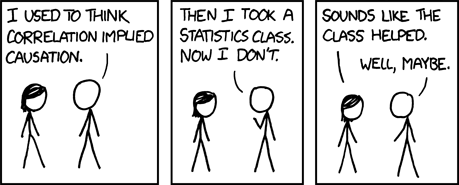
As xkcd reminds us, correlation doesn't imply causation. Regardless, it's interesting to see what it looks like.


12 May 2012

Wearing pajama bottoms to a thesis defense

The last part of March and all of April was dedicated to a high intensity freakout over finishing my MS thesis and giving my defense. Graphene-silicon interfaces, hybrid devices...totally fascinating and life consuming stuff. Interestingly, this was all done remotely. Research and measurements were finished before I moved halfway across the country to my new university, but my masters adviser and I spent some significant time since then determining what all those measurements meant.

Regular phone calls were critical to keep everyone on track. Once a week, all the questions and concerns, updated graphs and edits were given a thorough run down. Logistics were sorted out - who would be on the committee? Do I need to schedule a room? Can everyone work with soft copies of the thesis or should I mail drafts back east? I think this was a key piece to keeping on schedule and still defending by the semester deadline.

Thesis drafts and edits were kept in Dropbox. My adviser pointed out that it provided a nice, passive-aggressive way of reminding him to check my updates since a little notification would show whenever I saved my edits or a new version.

The thesis itself was conducted via Skype. There were minor hitches (video freeze, anyone?) but the call clarity was solid and there was a live presentation of the slides at both ends. Some practice runs of the presentation involved as much debate of technical issues as they did the material of my presentation. I'm not sure if this took away from anything, but it made me very aware of the experience for all parties.

Most importantly, I passed. With all the typing and talking behind me, I think this might make a smashing article for one of the IEEE journals. Especially since all this free time has just opened up in my schedule.

16 February 2012

At least whiteboards are quieter...


It's a little bit shocking to me when lectures are delivered exclusively on a chalkboard. Just in general. In engineering and technology disciplines, I find it alarming. Think about the resources and media that are available. We have videos, animations and pictures all over the web. There are online university classes, where you could have “guest” lecturers from some of the world's most prestigious institutions. And why so many lectures anyway? I think labs and simulations are even better. I certainly prefer them, being a visual and kinesthetic learner.

I don't discount the value of writing things down. Working through problems by hand can be much more tangible. Writing down a derivation helps me remember and makes it easier to catch errors during lectures. Plus, I haven't learned to type equations fast enough to keep up in class. Now I'm considering tablet options instead.

I'm surprised that we still get assignments handed out by worksheets, turned in handwritten, no website with additional references or course information, and a general 'hardcopy-ness' to every aspect of a class. This certainly isn't true of all my classes, but I have a fascinated frustration when I see the resistance to learn and adapt to new tools.

I'm giving myself a project this semester of trying out a bunch of new scientific and math programs on my computer. I primarily use a Linux system, so I'm giving preference to open source (and free - I'm a grad student after all) programs. I thought using my homework assignments would give me specific problems to try out with these tools, rather than a vague task that I'll never start. I started to notice that resistance in myself before I left my old job, and now I need to train myself out of it.